The Tarot de Marseille: Everything You Need to Know (And What Nobody Tells You)
You search "tarot card meanings" and get dozens of sites recycling the same lukewarm content: "the tarot is a deck of 78 cards used for centuries for divination."
Thanks. Very helpful.
This guide is different. Here, you'll discover the Tarot de Marseille as it actually is — a symbolic system of staggering depth, forged through centuries of transmission, and one that most online "experts" only understand superficially.
The Tarot de Marseille is not an oracle. It's a mirror. And the difference between the two changes absolutely everything about your practice.
Whether you're a complete beginner or an advanced practitioner, this guide covers the essentials: history, structure, symbolism of the 22 Major Arcana, reading methods, and practical resources to go deeper. Each section links to in-depth articles for those who want to dig further.
History of the Tarot de Marseille: From Origins to Myths
The Tarot de Marseille wasn't born in Marseille. First surprise.
The oldest documented tarot decks appear in northern Italy in the 15th century — the *tarocchi* of the courts of Milan and Ferrara. These decks were used for *trionfi*, an aristocratic card game, not divination.
Divination through tarot only appears in the 18th century, when Antoine Court de Gébelin published *Le Monde primitif* (1781) and claimed — with zero historical evidence — that tarot originated in ancient Egypt.
The Egyptian Myth vs. Historical Reality
Court de Gébelin invented a legend that persists to this day. No, tarot doesn't come from Egypt. No, it wasn't designed by Thoth. No, the Romani people didn't bring it from the Orient.
What we actually know: - 15th century: First *tarocchi* in Italy (Visconti-Sforza, ~1440-1450) - 16th-17th centuries: The game spreads to France; Marseille card makers standardize the design - 18th century: Etteilla creates the first explicitly divinatory tarot - 19th century: Éliphas Lévi connects tarot to Kabbalah - 20th century: Jodorowsky and Camoin restore the historical Tarot de Marseille
For a complete deep dive into this fascinating history, check out our dedicated article on the history of the Marseille Tarot at cartomaniac.com/en/blog/history-of-marseille-tarot.
Tarot de Marseille vs. Other Traditions
The tarot world splits into several major traditions:
The Tarot de Marseille (TdM) — the French tradition. Medieval symbolism, no figurative scenes on pip cards, codified colors (red, blue, flesh, yellow). The Conver TdM (1760) restored by Camoin-Jodorowsky is considered the gold standard.
The Rider-Waite-Smith (RWS) — the Anglo-Saxon tradition. Created in 1909 by Arthur Edward Waite, illustrated by Pamela Colman Smith. Every pip card has an illustrated scene, making learning easier but directing interpretation.
The Thoth Tarot — Aleister Crowley and Lady Frieda Harris (1944). Highly esoteric with explicit astrological and Kabbalistic correspondences.
What makes the TdM special: it doesn't tell you what to think. The unillustrated pip cards force your intuition to do the work. The TdM is a tool for emancipation, not an illustrated dictionary.
Structure of the Tarot de Marseille: 78 Cards, One Universe
The 22 Major Arcana: The Initiatory Journey
The 22 Major Arcana form the heart of the Tarot de Marseille. They tell a story — from The Fool (0), the unnumbered traveler, to The World (XXI), total accomplishment.
This isn't a simple metaphor. Each arcanum represents a stage of psychological and spiritual transformation that every human being goes through during their lifetime.
The key stages of the journey:
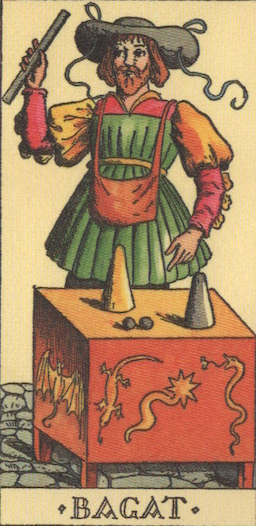
The Magician
Each arcanum deserves its own in-depth article — and we've written them all. The links above take you to detailed analyses of every card.
The 56 Minor Arcana: The Language of Daily Life
The Minor Arcana are often overlooked by beginners. This is a fundamental mistake.
If the Major Arcana describe the great archetypal forces of existence, the Minor Arcana map daily life — concrete situations, relational dynamics, practical challenges.
The 4 suits and their meanings:
- Wands (Fire): Action, creativity, enterprise, vital energy - Cups (Water): Emotions, relationships, love, intuition - Swords (Air): Mind, conflicts, communication, truth - Pentacles (Earth): Material world, finances, body, concrete achievement
The 16 court cards (Page, Knight, Queen, King) represent personalities or aspects of yourself in each domain.
For a complete exploration of the Minor Arcana, check out our article on the Minor Arcana, the subtle language of everyday at cartomaniac.com/en/blog/minor-arcana-subtle-language-of-everyday.
Tarot de Marseille Symbolism: Reading Beyond the Images
The Language of Color
In the Tarot de Marseille, nothing is decorative. Every color is a symbolic code:
Red: Action, desire, blood, living matter. When red dominates a card, the energy is earthly, passionate, embodied.
Blue: Spirituality, receptivity, cosmic water. Blue is the color of meditation, listening, the divine feminine.
Flesh: Humanity, incarnation, the body. The flesh color reminds us that tarot speaks of human beings, not abstractions.
Yellow/Gold: Light, knowledge, solar energy. Yellow is the color of awakened consciousness.
For a complete analysis of the TdM's color code, read our article on the symbolic colors of the Tarot de Marseille at cartomaniac.com/en/blog/symbolic-colors-of-marseille-tarot.
Numerology in the Tarot
Each number in tarot carries a specific vibration:
1 (The Magician): Beginning, unity, pure potential 2 (The High Priestess): Duality, gestation, receptivity 3 (The Empress): Creation, explosion, fertility 4 (The Emperor): Structure, stability, order 5 (The Hierophant): Transmission, bridge, ideal 6 (The Lovers): Choice, beauty, harmony 7 (The Chariot): Action in the world, conquest 8 (Justice): Balance, perfection, law 9 (The Hermit): Crisis, wisdom, fertile solitude 10 (The Wheel): Completed cycle, new beginning
Numerology and tarot share common DNA. Our article on sacred numerology of the Tarot de Marseille at cartomaniac.com/en/blog/sacred-numerology-of-marseille-tarot explores these connections in depth.
Gaze Direction and Positioning
A detail that 90% of tarot websites ignore: the direction characters are looking in the TdM is a major element of interpretation.
- A character looking left turns toward the past, interiority, reflection - A character looking right turns toward the future, action, exteriority - A character looking straight ahead addresses you directly
In a spread, characters who look at each other create a dialogue. Those who turn their backs signal a break or refusal.
This positional reading is specific to the TdM and doesn't exist in Rider-Waite-Smith. It's one of the major advantages of this tradition.
Reading Methods: From Simple to Complex
The Cross Spread: The Classic Method
The cross spread is the most popular method — and for good reason. It's structured, clear, and allows a reading in just minutes.
Layout: - Position 1 (center): The querent, current situation - Position 2 (left): What works in their favor - Position 3 (right): What works against them - Position 4 (bottom): The solution, advice - Position 5 (top, optional): The synthesis
Our complete guide on how to interpret a cross spread details each position with examples: cartomaniac.com/en/blog/how-to-interpret-a-cross-spread.
The Grand Spread: 15 Cards for a Complete Overview
For complex questions requiring a global vision, the 15-card Grand Spread is the ideal tool.
It covers all life domains — love, work, finances, health, personal development — and reveals hidden dynamics between these areas.
Try our free Grand Spread tool at cartomaniac.com/en/grand-tarot. Draw 15 cards and receive a complete interpretation, no registration, no ads.
Specialized Spreads: Shadow Work and Exploration
Beyond classic spreads, tarot offers powerful methods for inner work:
The Shadow Work spread uses tarot as a therapeutic tool to confront your unconscious patterns, repressed fears, and repetitive cycles. Our article on 5 tarot spreads to confront your shadow at cartomaniac.com/en/blog/5-tarot-spreads-to-confront-your-shadow explores these techniques in detail.
The lunar spread aligns your practice with moon cycles for amplified power. Discover how in our article Tarot and lunar cycles: cartomaniac.com/en/blog/tarot-and-lunar-cycles.
Preparing Your Reading Space: Ritual and Intention
A tarot reading without preparation is like a concert without tuning. Technically possible, but the result will be mediocre.
Preparation isn't superstition. It's applied psychology: by creating a ritual framework, you signal to your unconscious that it's time to switch to receptive mode.
The fundamentals:
- Space: A quiet, clean place where you won't be interrupted - Inner state: 2-3 minutes of deep breathing before touching the cards - Intention: Formulate your question clearly — not "what's going to happen?" but "what do I need to understand about...?" - Shuffling: Shuffle while thinking about your question. Shuffling isn't mechanical, it's meditative
For a complete guide on preparing a sacred reading space, check out our dedicated article at cartomaniac.com/en/blog/ritual-and-preparation-sacred-space-for-readings.
Tarot and Other Disciplines: Astrology, Numerology, Spirituality
Tarot and Astrology: Planetary Correspondences
Each Major Arcana in the TdM is associated with a zodiac sign or planet:
- The Fool → Uranus (freedom, disruption)
- The Magician → Mercury (communication, skill)
- The High Priestess → The Moon (intuition, mystery)
- The Empress → Venus (love, creation)
- The Emperor → Aries/Mars (authority, action)
- The Hierophant → Taurus/Jupiter (tradition, expansion)
These correspondences significantly enrich interpretation. If you know your birth chart, you can identify which arcana resonate most with your astrological configuration.
Calculate your birth chart for free at cartomaniac.com/en/astrologie/natal to discover these resonances. And to deepen the tarot-astrology connection, check out our complete love compatibility guide at cartomaniac.com/en/blog/love-compatibility-complete-guide-by-sign.
Tarot and Numerology: The Hidden Meaning of Numbers
Tarot and numerology share the same fundamental language: numbers.
Your life path number in numerology corresponds to a Major Arcana in tarot. If your life path is 3, The Empress is your birth card. If it's 9, it's The Hermit.
This connection between your birth number and a tarot card reveals your life mission from a fascinating symbolic angle.
Discover your life path and associated arcanum in our complete guide on the 9 life paths in numerology: cartomaniac.com/en/blog/9-life-paths-complete-numerology-guide.
Tarot and Personal Development: Beyond Divination
The Tarot de Marseille isn't reserved for "predicting the future." It's a self-knowledge tool of formidable power.
Contemporary uses:
- Coaching: Certified coaches use tarot as a questioning tool - Creative writing: Tarot as a scenario and character generator - Meditation: Contemplation of an arcanum as a meditative focal point - Shadow Work: Exploring repressed aspects of the psyche through symbolism - Decision making: Not to "know what to do" but to clarify what you feel about each option
Tarot is a mirror, not a crystal ball. The difference is fundamental: the crystal ball gives you answers, the mirror reflects your own questions — and that's infinitely more powerful.
Common Beginner Mistakes: What Sabotages Your Readings
After years of practice and teaching, here are the mistakes that keep coming back:
Mistake 1: Asking the same question repeatedly. Tarot isn't a vending machine. If you don't like the answer, drawing again won't get you a better one.
Mistake 2: Looking for predictions instead of understanding. "Will I find love?" is a bad question. "What's preventing me from opening up to love?" is an excellent one.
Mistake 3: Ignoring the Minor Arcana. They make up 72% of the deck. Ignoring them is like reading a book while skipping three-quarters of the pages.
Mistake 4: Interpreting without context. The Tower isn't always a catastrophe. The Devil isn't always negative. The Sun isn't always positive. Everything depends on position, question, and surrounding cards.
Mistake 5: Forgetting your own intuition. Books are guides, not laws. If your gut feeling contradicts the manual, follow your gut.
For a complete list of traps to avoid, check out our article on common mistakes in tarot reading: cartomaniac.com/en/blog/common-mistakes-in-tarot-reading.
FAQ: Your Questions About the Tarot de Marseille
Can the Tarot de Marseille predict the future?
No — and that's its strength. The TdM doesn't predict the future; it illuminates the present. It reveals dynamics at play, tendencies, potentials. The future isn't written: it's being built every moment, and tarot helps you build with awareness.
Do you need special gifts to read tarot?
No. Tarot is a symbolic language that can be learned. Like any language, it requires practice, patience, and a good teacher (or good books). Intuition develops with practice — it's not a prerequisite.
Can you read cards for yourself?
Yes, and it's actually recommended for beginners. Reading for yourself develops your sensitivity to symbols and your capacity for self-reflection. The trap: don't confuse what you *want* to see with what the cards *show*.
What's the difference between Tarot de Marseille and Rider-Waite?
The TdM is older, more austere, and doesn't offer figurative scenes on pip cards. The RWS (1909) illustrates every card, which makes learning easier but can limit imagination. The TdM demands — and rewards — deeper intuitive work.
How long does it take to learn tarot?
The basics in a few weeks. Solid mastery in 1-2 years of regular practice. True expertise, never — because tarot reveals new layers of meaning as you grow.
Which tarot deck should I choose to start?
For Tarot de Marseille: the Camoin-Jodorowsky or the CBD Tarot de Marseille (free online). For Rider-Waite-Smith: the original US Games edition. Choose a deck you find visually appealing — you're going to spend a lot of time looking at it.
Is tarot compatible with my religion?
Tarot is a symbolic tool, not a religion. It requires no particular belief. Christians, Buddhists, atheists, and agnostics all practice tarot. It's a psychological mirror that works independently of your spiritual convictions.
Are online readings valid?
Online readings use pseudo-random algorithms, not physical shuffling. The question is: are you looking for synchronicity (physical reading) or symbolic reflection (online reading)? Both have value. Try our free reading at cartomaniac.com/en/grand-tarot to form your own opinion.
Can AI replace a human tarot reader?
AI can provide accurate symbolic interpretations but cannot replace the presence, intuition, and listening of a human reader. We covered this topic in depth in our article AI vs Intuition at cartomaniac.com/en/blog/ai-vs-intuition-algorithms-will-never-replace-tarot-reader.
Where should I actually start?
1. Get a deck you like 2. Draw one card per day for a month 3. Journal your impressions 4. Read the articles on this blog to deepen your understanding of each arcanum 5. Try our free reading tool at cartomaniac.com/en/grand-tarot to familiarize yourself with the cards
Start Your Journey with the Tarot de Marseille
The Tarot de Marseille is one of the richest symbolic systems ever created by humanity. It doesn't give answers — it asks the right questions.
If you've made it this far, you're not just casually curious. Something in tarot is calling to you. Listen to that call.
Next steps:
- Draw your cards now: Try our free 15-card Grand Spread at cartomaniac.com/en/grand-tarot - Explore the Emotion Wheel: A unique tool combining tarot and emotional intelligence at cartomaniac.com/en/tarot-wheel - Discover your birth chart: The links between tarot and astrology start with your sky map at cartomaniac.com/en/astrologie/natal - Dive into the Arcana: Each major arcanum has its own dedicated article — start with the one that attracts you most
Tarot is a path. And every path begins with a first step.
*Yours begins here.*