You're asking your cards the wrong question
"Will he come back?" "Am I getting the promotion?" "When does the money show up?" That's roughly 90% of every question asked of tarot. It's also exactly why tarot keeps letting you down.
You're using an instrument built for introspection like it's a carnival crystal ball. You're asking a mirror to show you the window. No wonder the reflection comes back blurry.
Shadow Tarot flips the entire table. It doesn't answer "what's going to happen to me?" It answers a far more uncomfortable question: "what am I refusing to see in myself that's been running my life from backstage?" Less comforting, sure. Also the only thing tarot has ever actually been good at.
Why the shadow is the thing wellness culture won't touch
Let's be blunt: mainstream tarot has collapsed into pure fortune-telling. We turned the deck into a weather app for the soul. And that's a betrayal of what these cards actually are.
Carl Jung gave us the concept. Your shadow is everything you've repressed in order to be likable, employable, acceptable: your rage, your raw ambition, your envy, your hunger, your grief. Repressed doesn't mean gone. It means buried alive, and digging.
Here's the part nobody markets. Whatever you refuse to integrate doesn't quietly disappear. It runs you. It picks your partners, sabotages your wins, and shows up as the "random" pattern you keep repeating. Jung's line cuts to the bone: until you make the unconscious conscious, it will direct your life and you will call it fate.
Which is why this matters more in 2026 than it ever did. We live in the age of the optimized self — everyone's healed, glowing, on their best-life arc, at least on the grid. The shinier the front-facing version, the bigger the thing growing in the basement. Tarot is one of the few tools that can go down there and get it without a decade of therapy first.
The actual mechanism: how a card exposes your shadow
Projection, or why you hate certain cards
First uncomfortable truth: the card you find "ugly," "negative," or secretly pray you'll never draw is the exact doorway to your shadow.
In Jungian terms this is projection. What you reject in yourself, you see outside first — in other people, or printed on a piece of cardstock. The person who says "I hate The Devil, what an awful card" isn't talking about the card. They're talking about a bargain they've made with something they won't name out loud.
So in a shadow reading, the question is never "what does this card predict?" It's "what does this card stir up in me, right now, in my gut?" The emotional reaction IS the data. The discomfort is the message. Most readers spend their whole lives interpreting around the one feeling that actually mattered.
The mirror cards: The Devil, The Tower, The Moon
Three Major Arcana are the direct gatekeepers of the shadow. Not because they're "bad" — there are no bad cards — but because they speak the native language of the repressed.
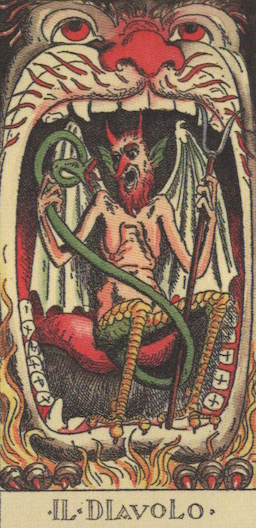
The Devil
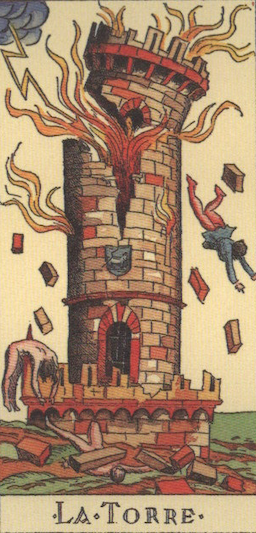
The Tower
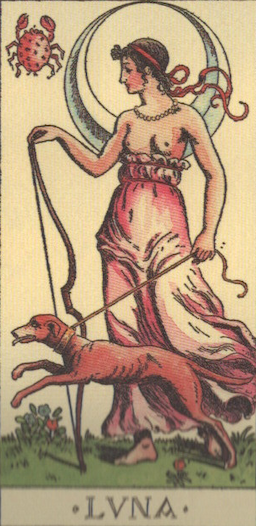
The Moon
The card you drew is never the card you think
Here's the beginner trap: taking the meaning at face value. Shadow work inverts that reflex on purpose.
You pull The Emperor? The fortune-telling read says "structure, authority, success." The shadow read asks: where are you a tyrant? Where do you control out of fear? Which kid in you felt so unsafe that they armored up into a tiny dictator?
You pull The Star, the "positive" card par excellence? Shadow asks: where are you hiding inside naive hope to avoid actually doing the hard thing? Optimism can be an escape hatch too.
Every arcanum has a lit face and a shadow face. Conventional reading floods the first one with light. Shadow work switches on the second. To understand the full symbolic architecture underneath this, the deepest reference is cartomaniac.com/en/blog/the-tarot-de-marseille-ultimate-guide.
Why Marseille beats Rider-Waite for this work
Strong opinion, fully owned: for shadow work, the Tarot de Marseille buries the Rider-Waite-Smith. And the reason is structural, not snobbery.
The Rider-Waite minor arcana are fully illustrated scenes. A figure weeps over three spilled cups; another lies face-down with ten swords in his back. It's comfortable — the card already tells you how to feel. That's also the problem: it thinks for you.
Marseille leaves the minors as abstract geometric patterns. No scene, no scripted emotion. Faced with a Marseille Five of Swords, your unconscious has nothing to grab onto — so it projects. And what it projects is precisely your shadow. The emptiness of the image becomes the screen for your psyche.
Marseille doesn't comfort you. It leaves you alone with yourself. For this work, that's the entire point. A Rider-Waite hands you a feeling; a Marseille demands you produce your own.
Do this tonight: the Mask and Face spread
Enough theory. Here's an exercise you can run within the hour, alone, with zero experience required. Grab your deck — or open the draw tool at cartomaniac.com/en/grand-tarot if you don't have cards on hand.
Step 1 — The Mask. Ask an unflattering, honest question: "What do I perform for the world so I'll be accepted?" Pull one card. Don't reach for a guidebook. Write down your first physical reaction. Tight throat? Relief? Irritation? Note it.
Step 2 — The Face. Second question: "What is this mask helping me hide?" Pull a second card, set it beside the first. That's your shadow for today. Look at it in silence for three full minutes. No interpreting. Just look.
Step 3 — The Pact. Third and last card: "What do I need to stop hiding this from myself?" This one isn't a prediction. It's an instruction to yourself.
The golden rule: judge no card. The one that repulses you has the most to teach you. Keep a journal. Run this spread once a week for a month, then reread it — your patterns surface like a photo in developing fluid. For more advanced variations, I broke down five full shadow spreads at cartomaniac.com/en/blog/5-tarot-spreads-to-confront-your-shadow.
The thing no one sells you at the psychic fair
Tarot will not change your future. It never had that power, and any honest reader knows it.
What it can do is far more dangerous: make you unbearably clear-eyed about the present. And clarity, unlike prediction, actually changes things — because you cannot transform what you refuse to look at.
Your shadow isn't your enemy. It's the part of you that got locked in a basement so you'd be easier to be around. All your courage, your desire, your raw power are down there in the dark, waiting behind The Devil and The Moon.
So next time you pick up your cards, ask the real question. Not "what's going to happen to me?" but "who am I avoiding becoming?" And if any line in this piece made you flinch — that flinch is a person. Send it to them.